
|
Big Spring Creek Fly Fishing Guiding and InstructionNeville PAFly FishingThe story of Big Spring Creek is one of legend. In the 1920's through 50's the stream was so famous
that the English sporting media regularly sent reporters over to do stories on this A summary of our study in a pdf may be found here: Ecosummary of Big Spring by Dr. Jack Black and Gene
Macri. Today Big Spring is a thriving spring creek .It has a few habitat problems but that has not kept it from
becoming the best kept secret in the fly fishing Unfortunately, to this day the scientific incompetence of the Pennsylvania Fish and Boat
At the present time Big Spring is in the best shape of any of the spring creeks in Cumberland and Franklin County Pennsylvania. The Sulfurs are returning in good numbers all the way to below the bridge below the source of the stream. There are good caddis hatches and the Blue Winged Olives come off all year long. Of course the stream has an abundance of midge hatches which can try one's soul but the trout seem to relish these things. But there are problems on Big Spring: The fish are damn hard to catch and very spooky! To Compound the problem the fish are leader shy and most anglers can't land a big fish on a 6 or 7x leader. For these reasons many anglers do not have much success because they don't have the skill level or knowledge necessary to do well. My answer to all of this: do your homework or get a good guide!
Directions to Big SpringYou can access Big Spring by going North on Route 11 from Shippensburg PA and heading towards Carlisle. Make a left at the sign that says Big Spring Fish Cultural Station. Below is a highway map in pdf to get you there. Highway Map of Big Spring
Big Spring EvaluationScore 3.3
Overall ecological condition: 3.4 out of 5 Fishery: 3.9 out of 5 Hatches: 3.5 out of 5 Fishing Pressure: 3 out of 5 (higher number indicates less pressure) Fly Anglers' Success Ratio: 2.5 (refers to highly skilled angler)
Big Spring NotesA number of strategies will work on Big Spring but I believe spotting the fish first or an area where they are is the most productive method. The fish will rise even in midday believe it or not to a properly place fly fished without drag because the fish are used to coming up especially for sulfurs and caddis flies. The fish in Big Spring more than any other spring creek take up feeding stations that you can observe. Why? Because feeding stations are related to insect activity and this stream has the best chance for hatch. These fish have become increasingly spooky and wary on this stream and too much false casting will send the fish swimming for cover. Small nymphs, midge larvae and small midges if fished properly will take fish when nothing out will. My favorite fly is a small sulfur nymph with an 18 size body tied thinly on a size 16 hook. Streamers will also work for large fish early in the morning and right before dark. The brookies in the ditch are also suspect to a scud or cressbug nymph fished right on the bottom on a light tippet and very small split shot.
You may use these articles. You can store them. You can read them. You may not change, republish, sell or redistribute these articles in anyway for any monetary gain. You may not add them to your collection and sell them etc. These articles are copyrighted and we will strictly enforce the copyright.© 2009 E. P. Macri Jr.What Flies Should You Carry on These Streams?
|
©2017 E. Macri All Rights Reserved |
 American spring creek which was comparable to the best English
Chalkstreams. Its native strain of brook trout were like no other that anyone could find. These fish were
selective sophisticated surface risers. But all that changed in the early 70's when the Pennsylvania Fish and
Boat Commission decided to put a massive hatchery at the source of Big Spring. In 1972 the hatchery started
and in 1973 was their first production. The brook trout fishery in the upper part of Big Spring crashed
shortly thereafter, and for the next 25 years the stream was maintained by stocking large fish and hatchery
escapes in the area known as the ditch. Ninety-eight percent of the rest of the stream had almost no trout.
Yet, the Pennsylvania Fish and Boat Commission told the public it was a habitat problem! In 1997 Dr. Jack
Black and I started a pro bono study on the stream with help from Ralph Shires and Bill Ferris local fly
anglers, and legal assistance from Kurt Weist of Citizens for Pennsylvania's Future. The results of that
study, the public outcry, and admittance by the Department of Environmental Protection in Pennsylvania that
our study was correct forced the closure of the hatchery. The Big Spring Watershed Association was formed
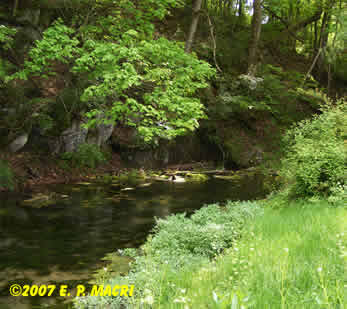
during this time period and continues to monitor the stream.(Photo above shows source of
Big Spring;©2007 E.P. Macri).
American spring creek which was comparable to the best English
Chalkstreams. Its native strain of brook trout were like no other that anyone could find. These fish were
selective sophisticated surface risers. But all that changed in the early 70's when the Pennsylvania Fish and
Boat Commission decided to put a massive hatchery at the source of Big Spring. In 1972 the hatchery started
and in 1973 was their first production. The brook trout fishery in the upper part of Big Spring crashed
shortly thereafter, and for the next 25 years the stream was maintained by stocking large fish and hatchery
escapes in the area known as the ditch. Ninety-eight percent of the rest of the stream had almost no trout.
Yet, the Pennsylvania Fish and Boat Commission told the public it was a habitat problem! In 1997 Dr. Jack
Black and I started a pro bono study on the stream with help from Ralph Shires and Bill Ferris local fly
anglers, and legal assistance from Kurt Weist of Citizens for Pennsylvania's Future. The results of that
study, the public outcry, and admittance by the Department of Environmental Protection in Pennsylvania that
our study was correct forced the closure of the hatchery. The Big Spring Watershed Association was formed
during this time period and continues to monitor the stream.(Photo above shows source of
Big Spring;©2007 E.P. Macri).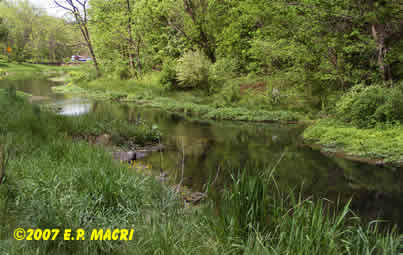 world. The upper area of the stream supports a large brook trout population. The wild rainbow
population have held their own with many fish over the 20 inch category. The wild browns that are left are few
in number but a couple hover in the 29 to 30 inch category! The streams gravels and habitat are advantageous
to brook trout and to a lesser extent rainbows but not browns who prefer larger gravel and more cover.
(Photo of the area known as the "Ditch" on Big Spring. Area has the largest brook trout
population per hectare probably in the country;©2007 E. P. Macri).
world. The upper area of the stream supports a large brook trout population. The wild rainbow
population have held their own with many fish over the 20 inch category. The wild browns that are left are few
in number but a couple hover in the 29 to 30 inch category! The streams gravels and habitat are advantageous
to brook trout and to a lesser extent rainbows but not browns who prefer larger gravel and more cover.
(Photo of the area known as the "Ditch" on Big Spring. Area has the largest brook trout
population per hectare probably in the country;©2007 E. P. Macri).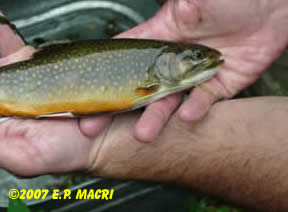 Commission continues to rear its ugly head. The higher ups including
the present executive director Dr. Austin have refused to admit that the hatchery was the cause of the
destroyed fishery. Even though the stream came bouncing back once the hatchery shut down (in fact the stream
actually began a recovery as soon as the hatchery reduced production by 70%). Today the stream is in great
shape and getting better. Of course, the advances of civilization are approaching and are threatening the
aquifers which are the vital blood of a spring creek. (Photo shows a wild native brook
trout on Big Spring; ©2007 E. P. Macri)
Commission continues to rear its ugly head. The higher ups including
the present executive director Dr. Austin have refused to admit that the hatchery was the cause of the
destroyed fishery. Even though the stream came bouncing back once the hatchery shut down (in fact the stream
actually began a recovery as soon as the hatchery reduced production by 70%). Today the stream is in great
shape and getting better. Of course, the advances of civilization are approaching and are threatening the
aquifers which are the vital blood of a spring creek. (Photo shows a wild native brook
trout on Big Spring; ©2007 E. P. Macri)Updated
Thru
October 2018
Limestoner Stream Reports: Pod Casts
Big Spring Creek
Falling Spring Run
Yellow Breeches Creek
Letort Spring Run
Green Spring
Folks this site uses cookies. All sites do. It's used for the ads and to insure the site runs correctly. I do not track you.